Master Database Normalization Step-by-Step (Without the Confusion)
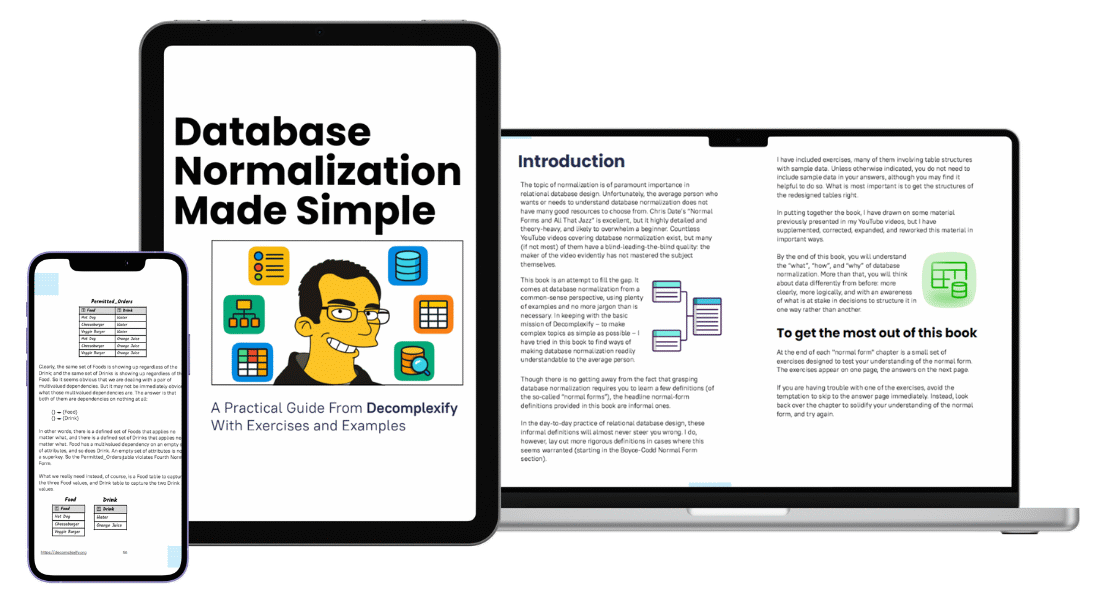
Grab The Practical Guide That Makes It Simple To Master Normalization
No Jargon Overload. No Convoluted Explanations. No Memorizing Rules Without Understanding What They're For.
With This Guide, You Will:
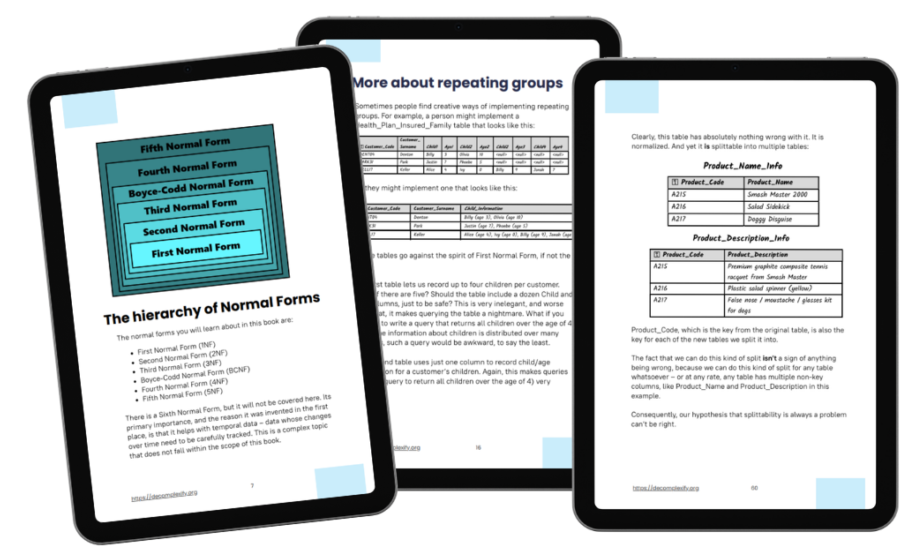
Is This Guide For Me?
The guide from Decomplexify has been written with the average person in mind, and assumes no prior knowledge or expertise. It is applicable to anyone who wants to gain a solid understanding of database normalization:
How Is This Different From Other Normalization Learning Resources?
Most normalization learning resources fall into two categories:
1) Very theoretical
Chris Date's book “Normal Forms and All That Jazz” is the most accurate and thoughtful account of database normalization I know – but it is decidedly not for beginners. It is full of passages like this:
To elaborate briefly: It’s certainly the case that every FD that holds in S is implied by these three FDs taken together, so these three certainly constitute a cover. Also, each of the three has a singleton dependant; no attribute can be dropped from any of the three determinants; and none of the three FDs can be discarded. Thus, it follows that the cover is in fact an irreducible one. By contrast, the following sets of FDs are also covers for the FDs that hold in S, but they’re not irreducible...
2) Crudely oversimplified
Simple is good, simplistic is not. Most beginner-friendly tutorials on normalization are the educational equivalent of “empty calories”.
That's not your failing. It's what happens when a tutorial glosses over complexity instead of embracing the challenge of trying to explain complex concepts little by little, step by step, so that people can have the satisfaction of achieving real understanding of a challenging subject.
People trust Decomplexify to explain complex topics in the simplest possible way, without dumbing them down. Decomplexify's explainer videos on YouTube get comments like this:
💬 “Someone give this guy a teacher’s award – one of the best breakdowns of a difficult subject I have seen.”
💬 “Seriously, I can’t thank you enough for this, the database course in my university made this look like a convoluted mess and you just explain it so simply like that.”
💬 “So well put together. Most people don’t bother going into it with examples and caveats the way you did :)”
💬 “I will never forget how hard and confusing to learn this topic was. Eventually, I had given up and just byhearted it without learning. I wish i had found this video before. Thank you for making this.”
💬 “Omg thank you so much for not throwing complex definitions and instead providing real life examples. Your vid is golden.”
💬 “I’ve been building databases for over 20 years and this is one of the simplest and clearest explanations I’ve ever seen.”
What You Get:
THE GUIDE: “Database Normalization Made Simple” (PDF): Definitive guide to database normalization and the normal forms – 1NF, 2NF, 3NF, BCNF, 4NF, 5NF – with exercises and solutions.
Plus:
🎁 BONUS: Interactive SQL facility featuring tables with normalization issues: these are pre-designed, pre-populated tables that you can query and play around with. Commentary and instructions provided. No special software needed; this runs in your browser.